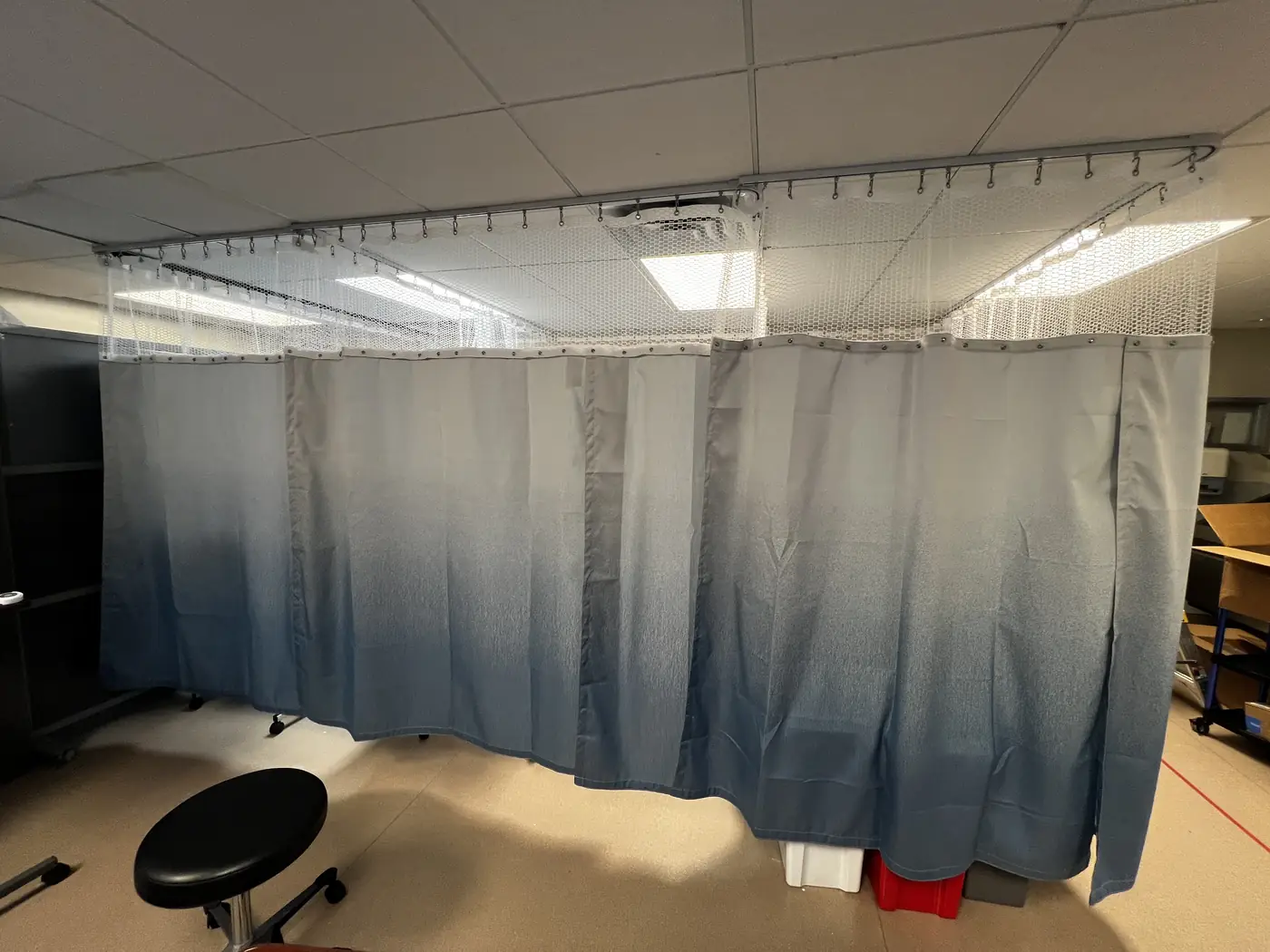
Curtain Track Installation
Free on-site measurement, no obligation
We reply the same business day.
Emergency? Mark it urgent and we move it to the front of the same-day queue.
Why hire us?
Anchored into structure
Fixings chosen for what is actually above the ceiling, identified before we quote rather than on installation day.
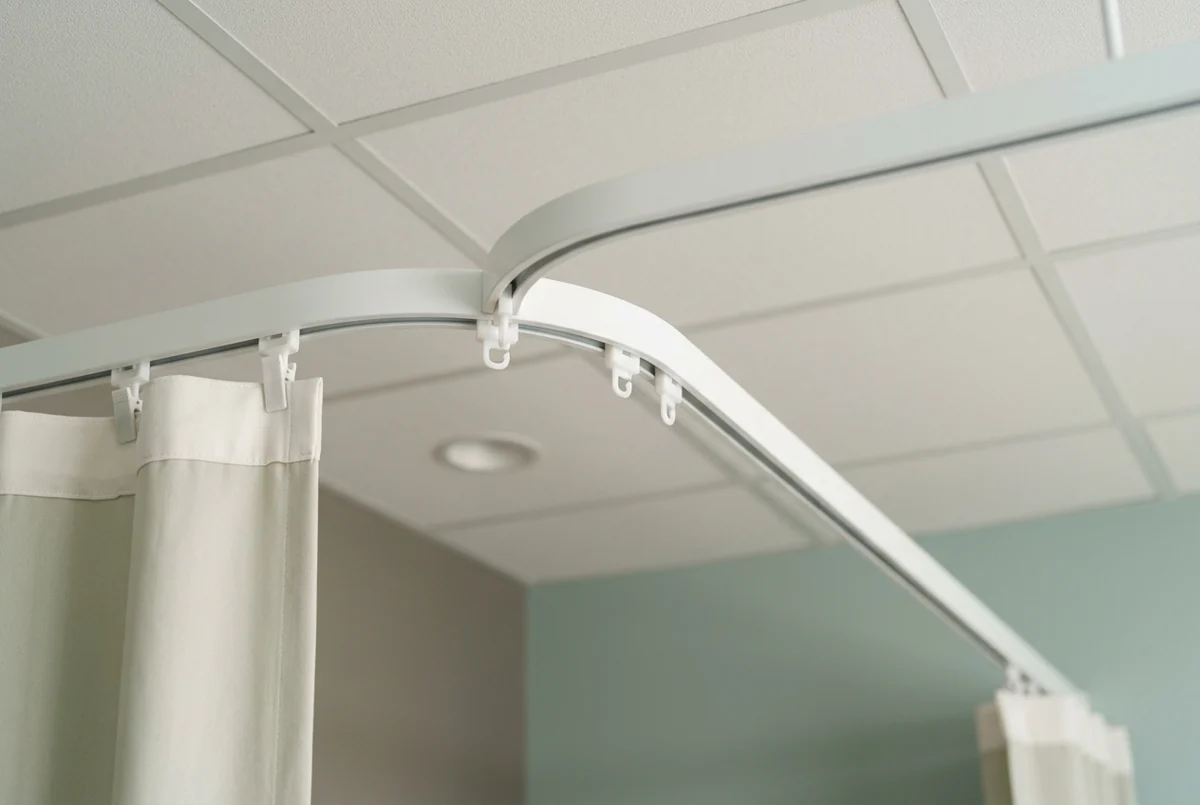
Factory-bent curves
Curved runs are bent to radius in the shop. Track bent on site is the usual cause of a curtain that binds.
Repair as well as replace
Where the track is sound, we replace carriers and stops rather than sell you a new system.
Clearance calculated
Track drop is part of the sprinkler clearance sum, so we set it per room instead of building-wide.
Services Included & Excluded
Complete transparency on what our service covers.
✓ Included
- Survey of the ceiling and the structure above it
- Ceiling-flush, suspended and open-structure mounting
- Factory-bent curved track and corner returns
- Carrier, end stop and splice supply and replacement
- Breakaway hardware where the risk assessment calls for it
- Track repair and re-hanging on existing systems
- Evening, weekend and phased scheduling
✕ Excluded
- × Sprinkler system modification — your fire protection contractor
- × Structural steel or blocking work above the ceiling
- × Ceiling grid replacement
- × Electrical and data work in the same ceiling
How it works
Four steps, and you can stop after any of them.
-
1
Tell us about the job
A few questions online. No phone call, no card, nothing to sign.
about 2 minutes -
2
We measure on site
Track runs, drop lengths, ceiling type and clearances — so the sizes are yours rather than standard.
free -
3
You get a written quote
By email, with the fabric named and its fire documentation listed. Nothing is priced before it has been measured.
after the survey -
4
Nothing is committed until you say so
Accept the quote and the order goes in, scheduled around your hours. Decline it and that is the end of it.
the quoted price
Track Types, Mounting and Clearance
Who this is for
Facilities engineers, project managers and maintenance leads who need track put up correctly the first time — in a new build-out, a refurbishment, or a room where the existing system has started to fail.
The curtain is the part people see. The track is the part that fails, and almost every "the curtain keeps jamming" call we take turns out to be worn carriers or a track that was never anchored into anything solid.
Track types
| Type | Where it suits | Notes |
|---|---|---|
| Ceiling-flush | Hard lids and suspended grid ceilings | The cleanest appearance and the shallowest drop, which helps the sprinkler clearance sum |
| Suspended on drops | Open structure, deep plenums, very high decks | Rod length becomes part of the clearance calculation |
| Curved / bent | Wrap-around bays, corner beds, imaging equipment | Bent to radius in the shop; on-site bending is what makes a track bind |
| Heavy-duty | Blackout and acoustic fabrics, long unsupported runs | Carrier and bracket spacing rated for the fabric weight |
Mounting: what is above the ceiling decides everything
Anchoring differs completely between substrates, and getting it wrong is the difference between a track that lasts fifteen years and one that pulls out of the board:
- Suspended grid — the grid itself carries very little. Fixings go to the structure above, not the tee bar, with the track hung so it does not load the ceiling.
- Drywall hard lid — needs blocking or a fixing rated for the substrate. A curtain applies a repeated sideways load, not a static one, which is why anchors that hold a picture do not hold a track.
- Concrete deck — straightforward, but drilling positions have to clear conduit and any post-tension cables.
- Open structure — suspended rods from the deck or steel, with the drop length feeding straight back into the clearance calculation.
We identify what is up there during the survey rather than discovering it with a drill on installation day, which is also how we avoid the other classic failure: a track fixed neatly into a ceiling tile.
Sprinkler clearance is a track question too
Under NFPA 13, a cubicle curtain is not treated as a sprinkler obstruction when the open mesh section extends at least 22 inches down from the ceiling — the mesh lets heat reach the sprinkler and water through it.
The part that is a track question rather than a curtain question: that 22 inches is the sum of the gap from the ceiling to the top of the curtain, the height of the track and its carriers, and the mesh panel itself. Choose a deeper drop and you need less mesh; mount flush and you need more. Deciding the track and the mesh separately is how a facility ends up with compliant rooms and non-compliant rooms in the same corridor.
Scope, stated plainly: this exception applies in light-hazard occupancies, which covers most patient care areas. Storage, mechanical and industrial spaces are classified differently, and we will say so rather than hanging a curtain and hoping.
Carriers, stops and the small parts
Most of a track's working life is decided by parts that cost very little:
- Carriers — the rollers or glides in the channel. New curtains on twenty-year-old carriers still drag, so we replace them as a matter of course on retrofit work.
- End stops — worn or missing stops are why a curtain comes off the end of the run.
- Splices — badly aligned joints in a long run are a snag point for the life of the track.
- Breakaway hardware — releases the curtain under load where behavioural health or some pediatric settings require it. Specified when your risk assessment calls for it, not by default.
Repair or replace
We would rather tell you the track is fine. On a survey we check the channel for distortion, the fixings for movement, the carriers for wear, and the run for alignment. If the channel is straight and the fixings are sound, carriers and stops are a fraction of the cost of a new system — and if it is not, we will tell you before you spend money on new fabric that will hang on a failing track.
What a track job costs
Quoted per facility rather than published, because the same linear footage can differ several times over. What raises it: hard lids and open structure over suspended grid; curved and bent runs; heavy-duty track for blackout or acoustic fabric; long spans needing extra support; and out-of-hours work. What lowers it: doing a whole floor in one visit, reusing sound channel, and straight runs at a consistent ceiling height.
Where we work
We serve healthcare and commercial facilities across the Bay Area and the greater Sacramento region — San Francisco, Oakland, San Jose, Fremont, Santa Clara, San Mateo, Walnut Creek, Berkeley, Sacramento, Elk Grove, Roseville, Folsom and the surrounding communities. Send a room count or a few photographs and you will have a response the same day.
Frequently Asked Questions
Our work
Photographs from jobs we have finished. No stock photography.