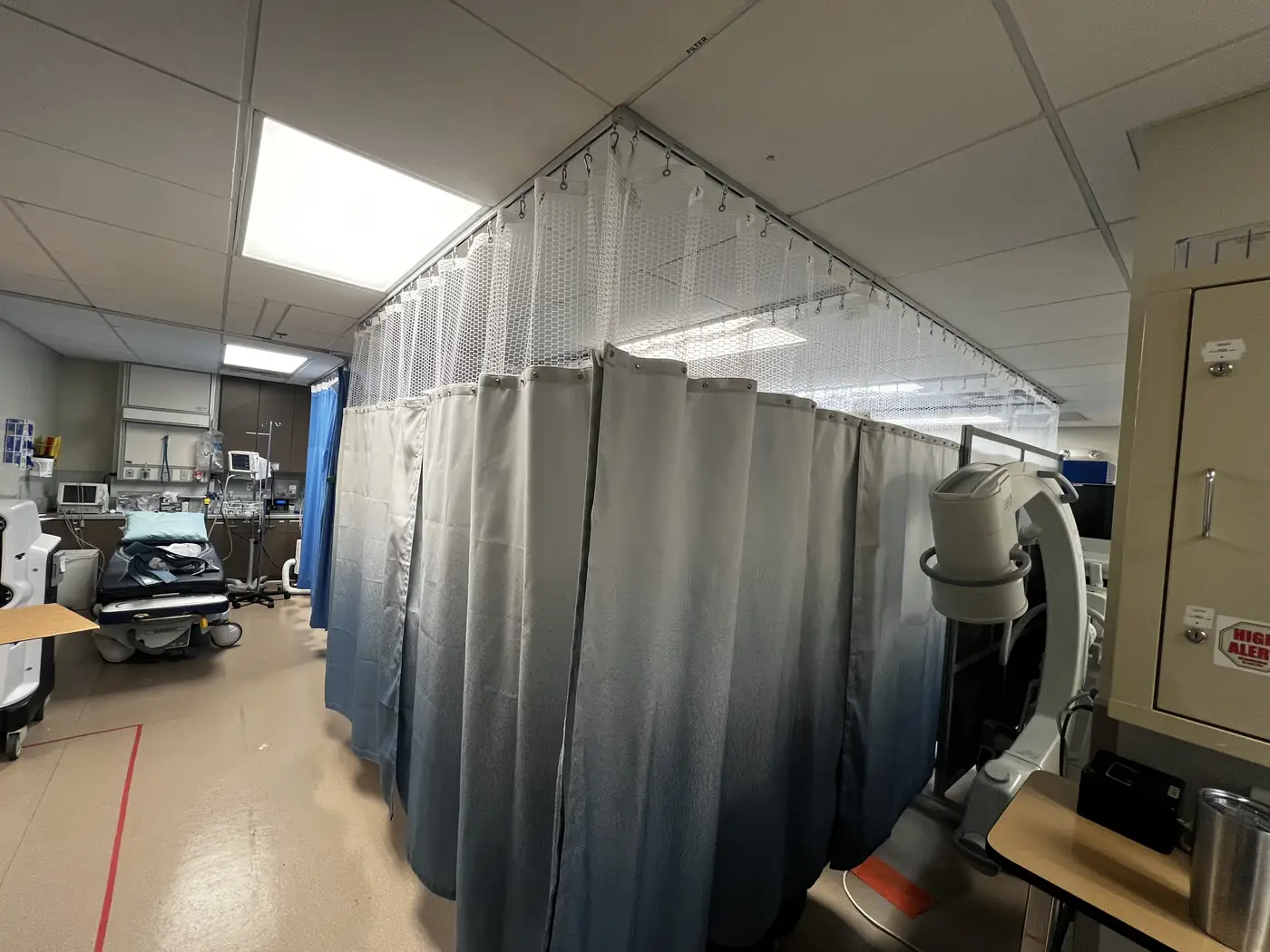
Cubicle Curtain Installation
Free on-site measurement, no obligation
We reply the same business day.
Emergency? Mark it urgent and we move it to the front of the same-day queue.
Why hire us?
Measured room by room
Ceiling height, track drop and sprinkler positions are measured per room, so the mesh height is right in every one of them.
California fire code
We work to Title 19 and OSFM registration, not just an out-of-state NFPA 701 certificate.
Around your hours
Evening, weekend and phased installations are routine. You do not lose a department for a day.
Kept compliant after
A second set supplied and labelled by room, so a curtain can come down for washing without leaving the bay bare.
Services Included & Excluded
Complete transparency on what our service covers.
✓ Included
- Free on-site measurement of every track run
- Fabric specification with fire documentation
- Mesh top height calculated per room for sprinkler clearance
- Ceiling-flush, suspended and curved track installation
- Carrier replacement on retrofit work
- Removal and disposal of the old curtains
- Room-by-room schedule of what was installed
- Evening, weekend and phased scheduling
✕ Excluded
- × Sprinkler system modification — that is your fire protection contractor
- × Structural work above the ceiling
- × Window treatments and blinds
- × Laundering — we supply the curtains, your own laundry washes them
How it works
Four steps, and you can stop after any of them.
-
1
Tell us about the job
A few questions online. No phone call, no card, nothing to sign.
about 2 minutes -
2
We measure on site
Track runs, drop lengths, ceiling type and clearances — so the sizes are yours rather than standard.
free -
3
You get a written quote
By email, with the fabric named and its fire documentation listed. Nothing is priced before it has been measured.
after the survey -
4
Nothing is committed until you say so
Accept the quote and the order goes in, scheduled around your hours. Decline it and that is the end of it.
the quoted price
Specification, Code and Installation
Who this is for
We install cubicle curtains and ceiling track for facilities where privacy is a clinical requirement rather than a nicety: surgery centers and pre-op bays, infusion suites, emergency and urgent care, dental and orthodontic operatories, veterinary treatment rooms, imaging and MRI suites, physical therapy gyms, dialysis units, and the shared rooms of assisted-living and skilled-nursing communities.
Most of our work is a single facility with anywhere from four to four hundred curtains, on a schedule built around your operating hours. We are equally happy replacing eight curtains in a dental office and fitting out a new floor before it opens.
Fabric selection
The fabric decides almost everything that matters later: how it launders, how long it lasts, whether it passes inspection, and whether infection prevention will sign off. These are the categories we specify from.
| Category | Typical use | What it gives you | Trade-off |
|---|---|---|---|
| Standard polyester | Exam rooms, clinics, offices | The workhorse. Launders repeatedly, holds colour, lowest cost per curtain | No antimicrobial finish |
| Antimicrobial-finished | Inpatient, ED, oncology, dialysis | A treated finish that inhibits microbial growth on the fabric between changes | Costs more; the finish is not a substitute for a change schedule |
| Disposable / single-use | Isolation, outbreak response, high-turnover bays | Changed rather than laundered — no linen loop, no rehang labour | Recurring cost, waste stream |
| Blackout / room-darkening | Sleep studies, imaging, recovery | Blocks light between bays | Heavier, needs track and carriers rated for the weight |
| Acoustic / sound-reducing | Consultation rooms, open plan | Cuts speech transmission between bays for spoken privacy | Heaviest option; confirm structural support |
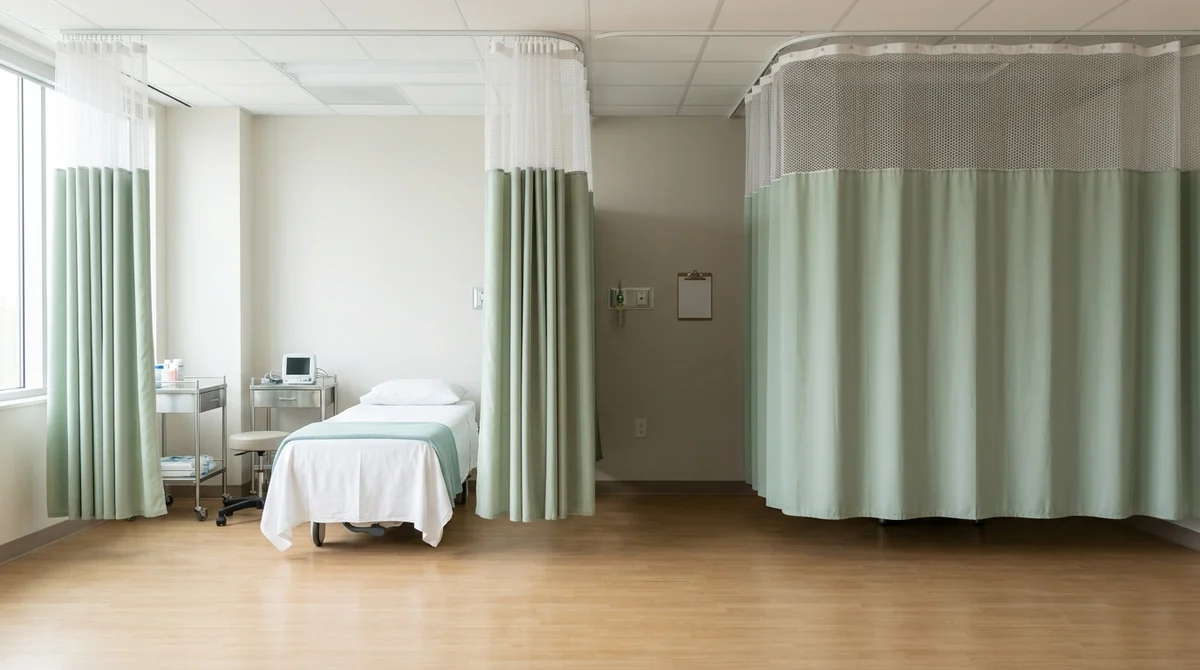
Every curtain we supply carries an open mesh top panel unless your ceiling makes it unnecessary — the reason is in the next section, and it is not cosmetic.
Fire code: what California actually requires
This is where most out-of-state suppliers leave a California facility exposed, so it is worth being precise.
NFPA 701 is necessary, and it is not sufficient here
NFPA 701 is the small-scale vertical flame test that curtain fabric is expected to pass, and a national supplier will tell you their fabric passes it. In California that is only half the answer. Fabric used in public buildings must additionally be registered with the Office of the State Fire Marshal (OSFM) under Title 19 of the California Code of Regulations, Division 1, Chapter 8. Hospital cubicle curtains are explicitly named in the scope of soft goods that this covers.
The practical consequence: a curtain that satisfies a specifier in Florida can still be written up by a fire marshal in California. When an inspector asks, the document they want is the OSFM registration for the fabric, not a mill's flame-test certificate.
The 22-inch mesh rule, and the part people get wrong
Under NFPA 13, a cubicle curtain is not treated as a sprinkler obstruction when the open mesh section extends at least 22 inches down from the ceiling — the mesh lets heat reach the sprinkler and lets water through without meaningfully distorting the spray pattern.
The detail that catches people out is what the 22 inches is measured across. It is not 22 inches of mesh. It is the total of three things stacked together:
- the gap from the ceiling down to the top of the curtain,
- the height of the track and its carriers, and
- the height of the mesh panel itself.
So a track suspended on 6-inch drops with a 16-inch mesh panel satisfies it, and so does a ceiling-flush track with a 20-inch mesh panel plus its carrier height. Order a fixed 18-inch mesh top for every room in a building with three different ceiling heights and some of those rooms will fail. We measure ceiling height and track drop room by room and size the mesh to suit — which is the single most common reason a facility calls us to fix somebody else's installation.
One scope note, stated plainly: this exception applies in light-hazard occupancies, which covers most patient-care areas. Storage, mechanical and industrial spaces are classified differently, and we will tell you when a room falls outside it rather than hanging a curtain and hoping.
Track, carriers and how they mount
The curtain is the part you see; the track is the part that fails. Most of the "the curtain keeps jamming" calls we take are worn carriers or a track that was never anchored into structure.
- Ceiling-flush track — fixed directly to a hard lid or into the grid of a suspended ceiling. The cleanest look, and the shallowest drop, which matters for the 22-inch calculation.
- Suspended track — dropped on rods from structure above, for open-structure ceilings, deep plenums, or where the deck is too high to fix flush.
- Curved and bent track — factory-bent to a radius for wrap-around bays, corner beds and imaging equipment. Bending on site is how you get a track that binds.
- Carriers — the rollers or glides in the channel. We replace worn carriers as a matter of course on a retrofit; new curtains on twenty-year-old carriers still drag.
- Breakaway hardware — where a curtain must release under load, typically in behavioural health and some pediatric settings. Specified when your risk assessment calls for it, not by default.
- End stops and splices — the small parts that decide whether a curtain runs to the end of the bay or stops six inches short.
Anchoring differs completely between a drywall lid, a suspended grid and open structure, and getting it wrong is the difference between a track that lasts fifteen years and one that pulls out. We identify what is above the ceiling before we quote, not on installation day.
How the job runs
- On-site measurement. We measure every run: track length, ceiling height, drop, floor clearance, door swings, sprinkler head positions and where equipment needs the curtain to stop. Free, and it is the step that prevents everything else going wrong.
- Specification and quote. You get fabric options with their fire documentation, a mesh height calculated for each room's ceiling, a track and hardware list, and a price with the quantities visible. Same-day response on quote requests.
- Installation. Scheduled around your hours — evenings, weekends and phased floor-by-floor work are normal for us, not an exception. We contain dust, protect finishes, take the old curtains away, and leave every room patient-ready.
- Handover. You receive the fire documentation for the fabric supplied, a room-by-room schedule of what was installed, and the option of a second set cut to the same track, so a curtain can come down for washing without leaving the bay bare.
What a job like this costs
We quote per facility rather than publishing a price list, because the same room count can differ several times over in cost and a list would mislead you either way. What we can do is tell you exactly what moves the number, so you can size the job before you call.
What raises it:
- Fabric grade. The gap between a standard polyester and an antimicrobial or acoustic fabric is the single largest line in most quotes.
- New track versus existing. Hanging curtains on sound track is a fraction of the cost of supplying and installing new track. Carrier replacement sits between the two.
- Ceiling type. A suspended grid is quick. Hard lids, open structure and anything needing drops or blocking above the ceiling take longer per foot.
- Curved and bent runs. Factory-bent track for wrap-around bays costs more than straight runs and has a lead time.
- Out-of-hours work. Nights, weekends and phased floor-by-floor installation carry a premium — usually a smaller one than the cost of closing the department.
- Curtain size. Ceiling height drives fabric consumption directly, and mesh height is set per room by the sprinkler clearance rule rather than by preference.
What lowers it: doing a whole floor in one visit rather than a room at a time, reusing track that is genuinely sound, standard fabrics where the clinical risk does not call for more, and booking the change at the same time as a planned closure you already have.
Send us a room count — or a few photographs of what is hanging now — and you will have a response the same day, with the quantities visible so you can see how the figure is built rather than being handed a single number.
Keeping them compliant afterwards
A question we are asked on nearly every job: how often do the curtains have to be changed?
The honest answer is that there is no universal mandated frequency. Neither the CDC nor The Joint Commission publishes a fixed interval for privacy curtains in non-isolation settings; the expectation is a risk-based approach set by your own infection prevention team. In practice most facilities land between every four weeks and quarterly depending on unit type, patient turnover and contact, and every credible protocol says the same thing about visible soiling: change it immediately.
What an inspector actually asks for is your written policy and evidence that it is being followed. Curtains are porous and cannot be disinfected in place — they get exchanged for clean ones. That is why most facilities buy two sets rather than one: a clean set goes up while the other is at your laundry, the bay is never bare, and the swap is a ten-minute job for your own team. We supply the spare set cut to the same track and logged room by room, so the record matches the policy you wrote.
Frequently Asked Questions
Top Service Areas
Our work
Photographs from jobs we have finished. No stock photography.