Privacy Curtains for Dental Offices
Most dental practices come to us with the same sentence: the open hygiene bay works beautifully for supervision and badly for privacy. Three or four chairs in one room, no walls between them, and every patient can see and hear the one next to them.
That is a real problem and a curtain is a real answer to part of it. It is not an answer to all of it, and this page is honest about which part.
What a curtain does and does not do in an operatory
| Problem | Does a curtain solve it? |
|---|---|
| Sightlines between chairs | Yes. This is what it is for, and it works |
| Patient dignity during treatment | Yes — being visible to strangers while in the chair is most of what patients object to |
| Conversation privacy | Partly. Fabric absorbs some sound and blocks none of it. Do not sell it as HIPAA compliance |
| Aerosols | No. A privacy curtain is not a barrier and does not behave like one |
The aerosol line matters enough to say plainly. After 2020 a number of suppliers began marketing cubicle curtains into dental as though they controlled aerosol spread between chairs. They do not. Aerosol control is ventilation, high-volume evacuation and time — a hanging fabric panel changes the sightline, not the air.
If a curtain is being specified as an infection-control measure rather than a privacy measure, that is worth catching before it goes in a purchase requisition, because it will not survive a question from anyone who knows the difference.
On sound, since every practice asks
A fabric panel absorbs a little high-frequency sound and blocks essentially none of it. In an open hygiene bay, a normal speaking voice carries to the next chair with or without a curtain.
What actually reduces overheard conversation in a dental practice is lower speech volume at the chair, background sound, and where the conversation happens — a treatment discussion held at the front desk is audible to the waiting room no matter what hangs in the operatory. A curtain helps because people speak more quietly when they cannot see who else is there, which is a real effect and a psychological one rather than an acoustic one.
If genuine speech privacy is the requirement, that is a construction question, not a curtain question, and we will tell you so rather than sell you a panel that will not deliver it.
The layout question nobody asks first
The instinct is to hang a curtain between every chair. It is usually wrong, and the reason is supervision: the open bay exists so a hygienist or a dentist can see across it. Curtain every gap and you have built four small rooms with poor light and no oversight.
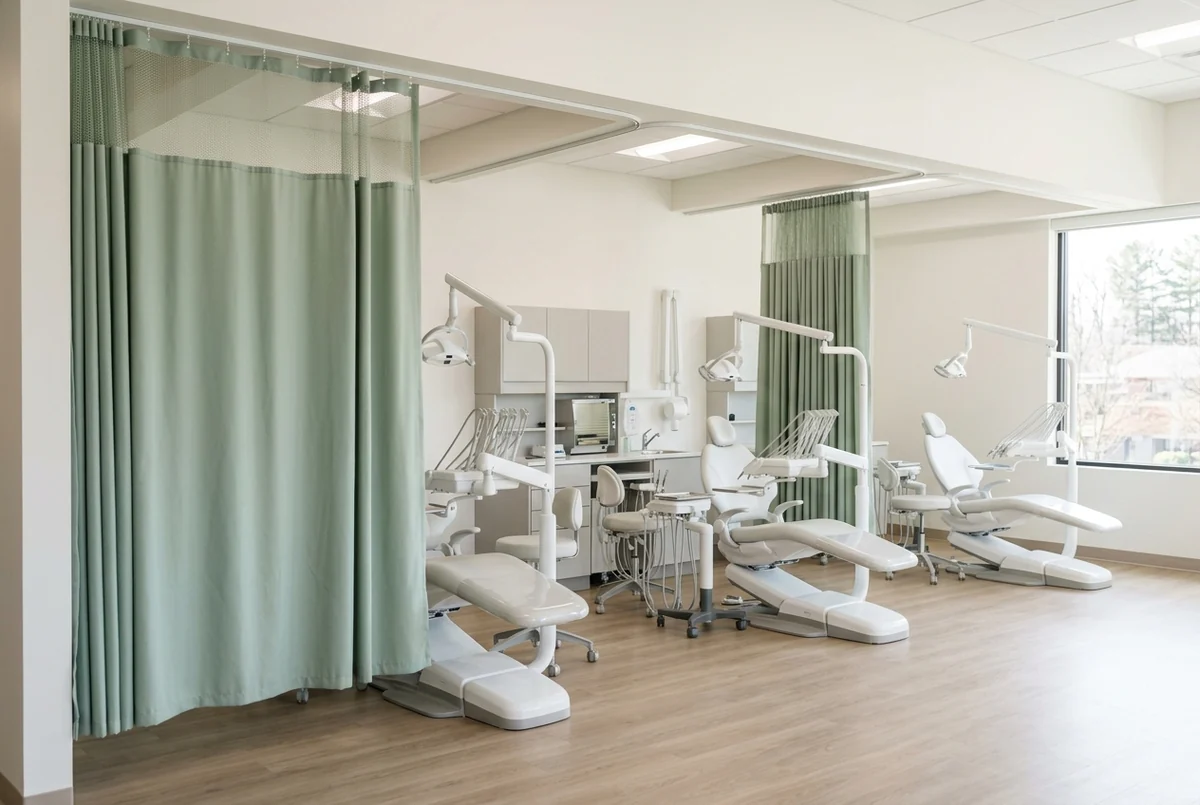
What works better in most practices we measure:
- Curtain the ends, screen the middle. The chairs at each end of the run get a full curtain; the gaps between the inner chairs get a shorter panel that blocks a seated sightline without closing the bay.
- Drawn only when needed. A curtain on a track can be open all morning and closed for one patient who asks. A partition cannot.
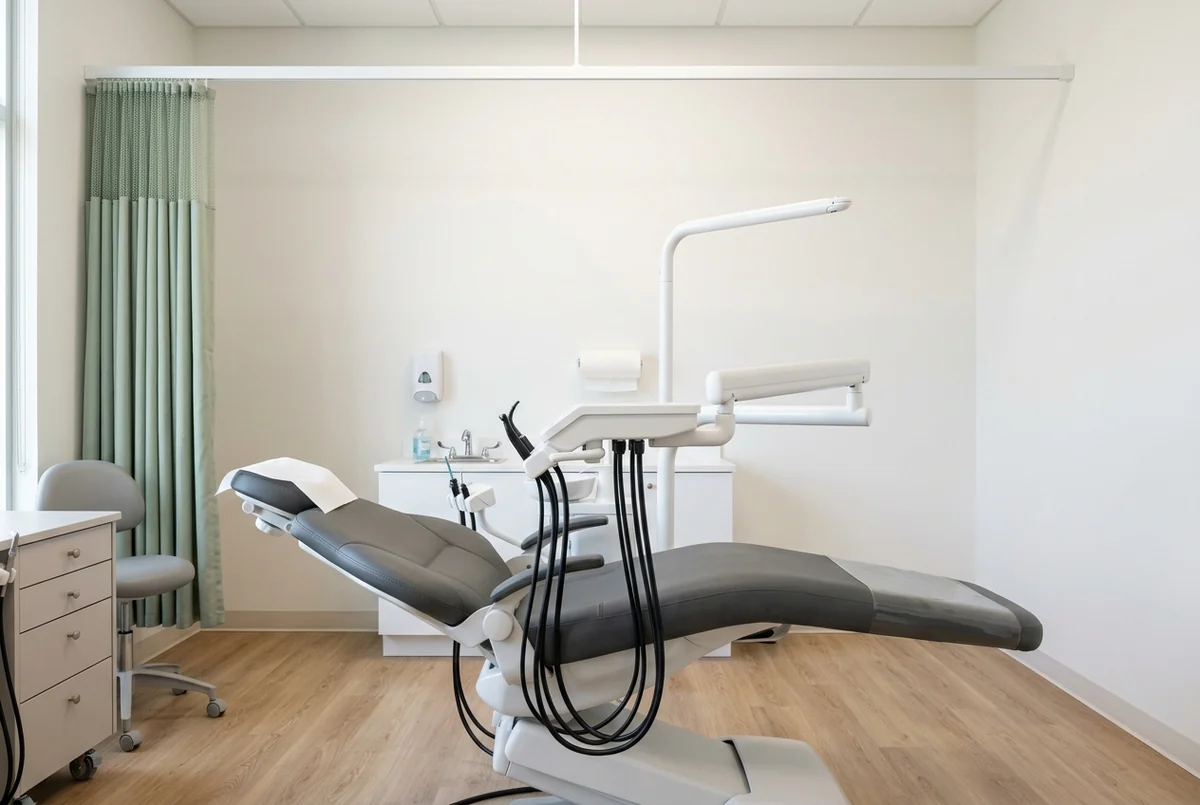
- Mind the chair swing. Dental chairs recline into space that a straight track ignores. The track has to clear the chair at full recline, with the delivery arm swung out, not at rest.
That last one is the most common measuring mistake in dental and the most annoying to fix afterwards, because correcting it means moving track rather than re-cutting fabric.
Ceilings in dental are not hospital ceilings
A great many California dental practices are in converted retail or office space — strip malls, second floors above shops, medical office buildings from the seventies. What that means for track:
- Lower ceilings. Often 8 to 9 feet rather than the 9 to 10 of a purpose-built clinic. Curtain drop and floor clearance both change.
- Ceilings that are not what they look like. A dropped grid with a hard deck well above it, or a hard-lid gypsum ceiling with no accessible void at all. Each takes different fixings and one of them takes a suspended track.
- Services in the way. Dental operatories are dense with them — lights, monitor arms, delivery units, vacuum lines. Track has to be routed around what is there, and what is there is rarely on any drawing.
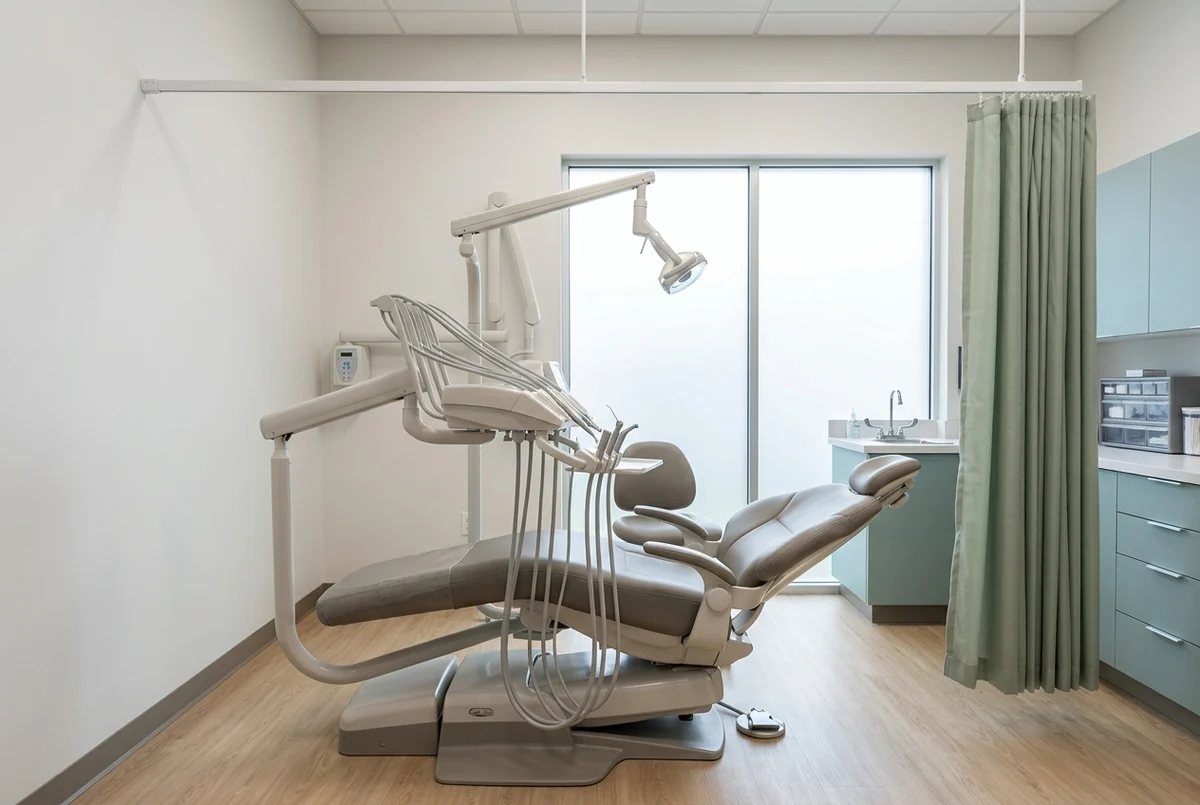
We survey the ceiling before quoting for exactly this reason. A quote given over the phone for a dental office is a guess about a ceiling nobody has looked at. Our curtain track installation page covers what the ceiling work involves once we know which kind you have.
Fire compliance still applies, and California adds to it
Smaller premises sometimes assume the fire rules are for hospitals. They are not — a fabric hanging in a place of business is regulated the same way whatever the size of the practice.
Two things a California dental practice should ask any supplier:
- Is the fabric registered with the State Fire Marshal? NFPA 701 is a test method. California maintains a registration scheme under Title 19, and registration is what an inspector here asks to see.
- Is the flame resistance inherent or applied? If it is a topical treatment, it depletes with washing and has a service life. Inherent flame resistance does not. The full comparison is on the fabric guide.
If your curtains hang below a sprinkler head, the mesh top is not optional either, and the clearance is measured from the finished ceiling rather than from the top of the fabric.
Cleaning, on a schedule a small practice can actually keep
A hospital has a linen contract. A dental practice usually does not, and a change schedule written as though it did will be ignored by the second month.
What tends to hold in a practice of two to six operatories:
- A defined interval that matches your patient volume rather than a number copied off a hospital policy
- A spare set, so a change is a swap taking minutes rather than a day with a bare bay
- Written triggers for an unscheduled change: visible soiling, a known exposure, any splatter
- A record of when each operatory was last changed — a sheet on the wall of the sterilisation room is enough
Most practices run this on two sets: one hangs while the other is at the laundry, so an operatory is never waiting on a wash. We supply the second set cut to the same track, which makes the swap a ten-minute job between patients.
Fitting it around a practice that is open
Dental has one advantage over almost every other healthcare setting: the schedule is predictable and there is usually a whole day in it. Most practices we work with run four or four-and-a-half days, and the closed day does the entire job with no disruption at all.
Where that is not available, an operatory can usually be released for a couple of hours between blocks, provided the work is a swap and not new track. Anything that opens the ceiling wants the closed day.
What we need to quote
- How many operatories, and whether the hygiene bay is open or partitioned
- Ceiling height, and whether the ceiling is a dropped grid or a hard lid
- Whether any track exists already
- Photographs of one operatory taken from the doorway, with the chair reclined if you can
- Your closed day, if you have one
We measure on site and bring physical fabric samples to the same visit. For a practice of this size that is usually one visit and one follow-up to install.
We cover the Bay Area and Sacramento.