Privacy Curtains for Dialysis Clinics
Dialysis has a privacy problem that no other outpatient setting has, and it comes from the one thing you cannot change about the treatment: the patient is in the chair for three to four hours, three times a week, for years.
Everyone in the unit knows everyone. Staff have to be able to see every patient at every moment. And the patient would still like not to be looked at while they are cannulated, while a dressing is changed, or while they are simply having a bad afternoon.
Those two requirements pull against each other, and getting the curtains right in a dialysis unit is mostly about how you resolve that tension rather than about the curtains themselves.
You cannot enclose a dialysis patient
This is the constraint that catches suppliers who have only ever done hospital wards. In a treatment bay, staff must maintain visual observation of the patient throughout the session — a patient on dialysis can develop a problem in seconds, and a curtain drawn fully around a station takes them out of view.
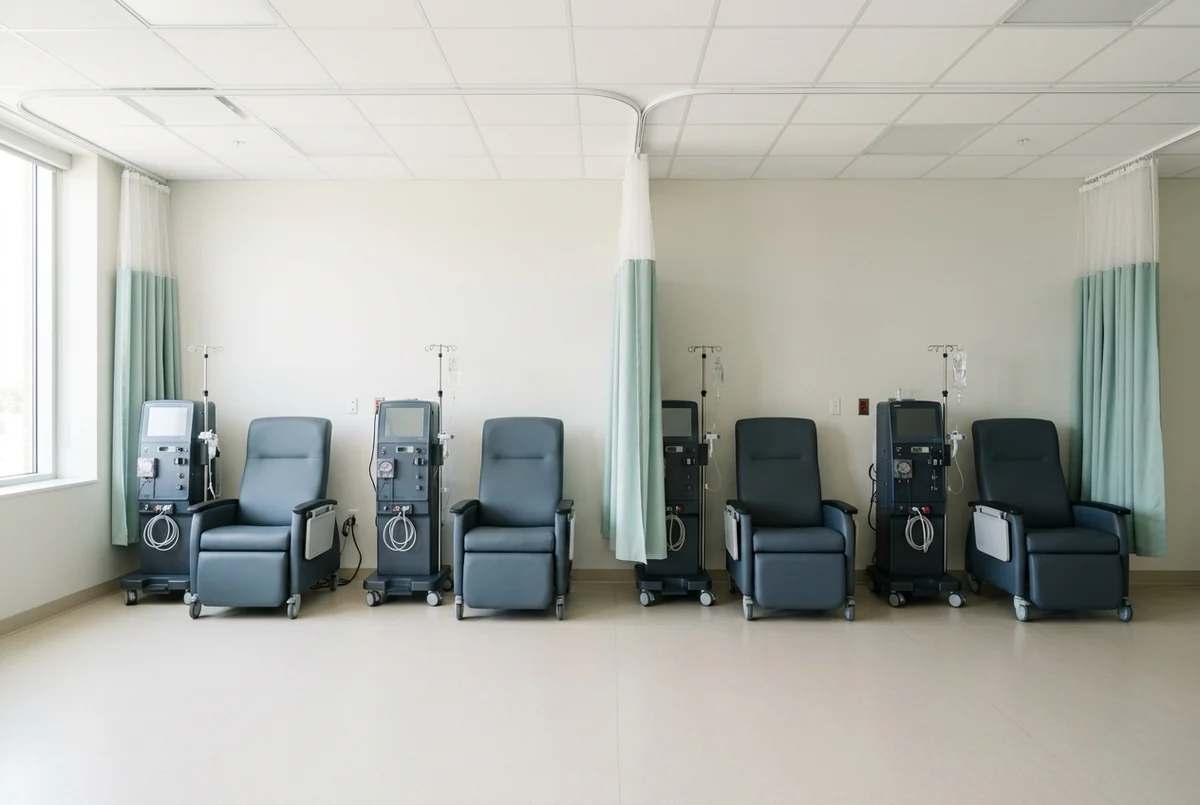
So the answer is never “curtain every station and close them.” What works is a curtain that is available rather than deployed:
- Between stations, not around them. A panel that blocks the sightline from the neighbouring chair while leaving the station open to the nurses’ line of sight.
- Closed for a procedure, open for the session. Cannulation, dressing changes, catheter care — these are the moments a patient wants covered, and they are minutes, not hours.
- Track that lets a panel park properly. A curtain that will spend most of its life open needs somewhere to stack that is not in front of a machine or across a walkway.
That last point sounds minor and is not. A panel with nowhere tidy to park gets pushed against equipment, gets caught, and gets replaced early.
What “mostly open” does to the hardware
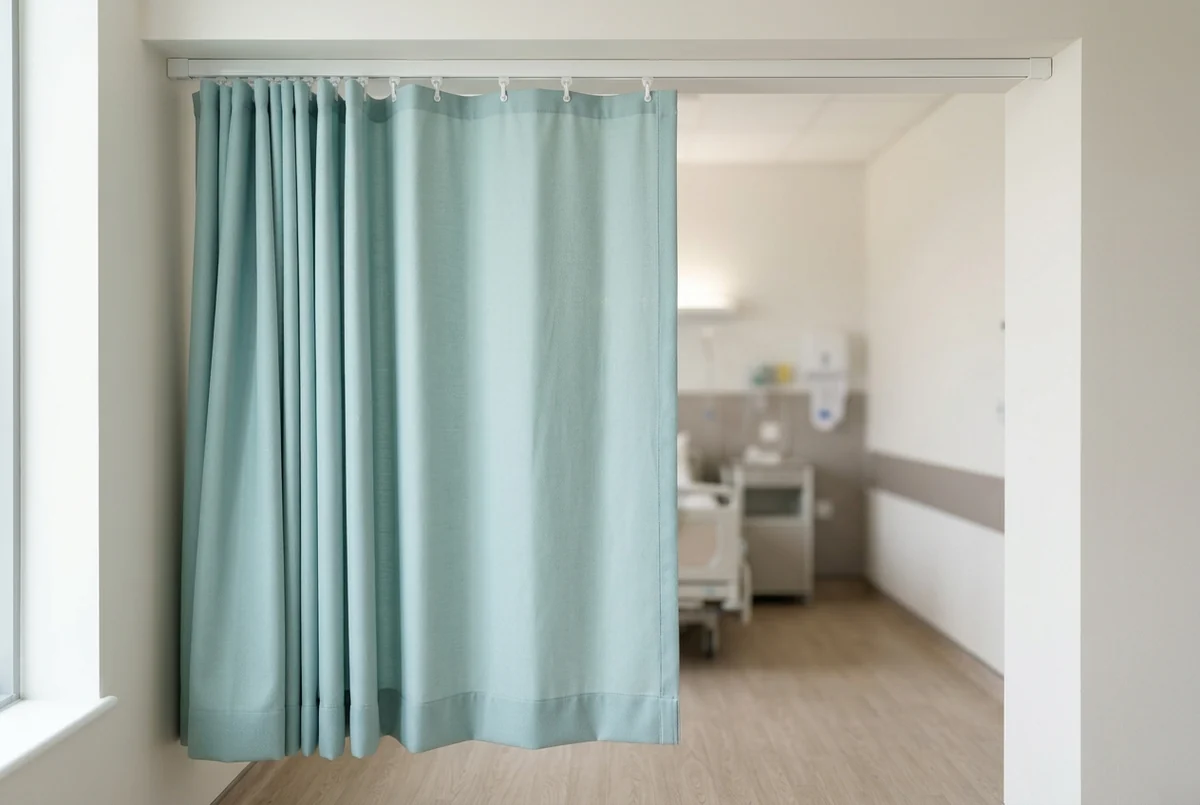
A ward curtain spends its life closed and gets drawn twice a day. A dialysis panel spends its life open and gets handled at every station, every shift. The wear lands somewhere different, and it is worth specifying for:
- Carriers do the work. Three shifts of opening and closing is roughly a thousand passes a year per station. Cheap carriers bind, then jump the track, then take the panel down with them.
- The leading edge takes the handling. Every hand that moves the panel touches the same vertical edge. That edge soils first, frays first, and is the honest place to look when deciding whether a set is due.
- Stack space is a specification, not an afterthought. A panel parked at the wrong end of a run sits across a machine or a walkway for four hours at a time.
The part that is not a specification
A hospital patient is a stranger passing through. A dialysis patient is in the same unit, often in the same chair, three times a week, for years. They know the staff, they know the other patients, and the other patients know them.
That changes what privacy means. It is not an occasional courtesy for an awkward moment; it is a condition of somebody’s ordinary week, indefinitely. A patient who is cannulated in full view of the same six people every Monday, Wednesday and Friday is not having one uncomfortable experience — they are having several hundred.
We mention it because it is usually what actually drives the enquiry, and it rarely appears in the specification. If it is what is driving yours, say so: it changes which stations we prioritise and where the panels are most worth having.
Infection control in a unit with bloodborne exposure
Dialysis units carry an exposure profile that changes how curtains are specified and how often they are changed. Blood is present, at every station, every session.
Three consequences worth stating plainly:
- The fabric will be wiped, not just washed. Spot decontamination between shifts is routine, so the surface has to tolerate a disinfectant wipe without degrading. A topically treated flame-retardant finish tolerates that badly.
- The change interval is shorter than a ward’s. Three shifts a day through the same station is three times the handling, and any schedule copied from an inpatient policy will be too slow.
- Isolation stations are a separate specification. If your unit runs dedicated hepatitis B isolation, those stations have their own requirements and their curtains should not be pooled with the rest of the rotation.
On fabric, the honest recommendation for dialysis is inherently flame-resistant, and it is a stronger recommendation here than anywhere else on this site. Between hot laundering and repeated disinfectant wiping, a surface treatment is being attacked from two directions at once. The fabric guide covers what that difference actually is.
Shift changeover is the only window you have
A dialysis unit running three shifts has almost no idle time, and the gaps between shifts are short and busy — the unit is being turned over, not resting.
In practice that leaves three options, in order of how much they disrupt:
| Window | What fits | Reality |
|---|---|---|
| Between shifts | A small number of station swaps | Short and shared with cleaning. Two or three stations, not twenty |
| After the last shift | Larger swap runs, carrier work, minor track repair | The realistic window for most of the work |
| A closed day | New track, reconfiguration, anything in the ceiling | Most units have one. It has to be booked well ahead |
A twenty-station unit is not a one-visit job unless it is a closed day, and a supplier who tells you otherwise has not counted the stations against the clock. We would rather phase it over three evenings than promise one night and leave stations down.
Sprinkler clearance in an open treatment floor
A dialysis floor is a large open room with a lot of curtain in it, which makes the sprinkler question more visible than it is in a bay layout.
The rule does not change: a solid curtain hanging too close to the ceiling blocks the spray pattern, and the fix is a mesh panel at the top. What changes is that a wide open floor usually has more sprinkler heads and more track runs, so getting the clearance wrong is wrong in more places at once.
Specify the clearance from the finished ceiling rather than from the top of the fabric, and the track and carriers are already accounted for. The section drawing on our measuring guide shows where the two common figures come from.
What we need to quote
- Station count, and whether isolation stations are included
- Whether the floor is open plan or divided into bays
- Ceiling height and ceiling type
- Whether existing track stays
- Your shift pattern and whether you have a closed day
- Photographs of a typical station and of one full track run
We measure on site, bring fabric samples to the same visit, and phase the installation around your shift pattern rather than asking you to lose chair time. The station work itself is cubicle curtain installation; everything on this page is how that job changes on a dialysis floor.
We cover the Bay Area and Sacramento.