Privacy Curtains for Surgery Centers
An ambulatory surgery center runs on a block schedule. Pre-op fills, cases run, PACU empties, and the whole thing repeats — six, ten, fourteen bays cycling all day, every one of them separated by a curtain that somebody’s hands touch on every single pass. Nowhere else in healthcare do privacy curtains get handled this hard, and nowhere else is there less room in the day to replace them.
This page is about the two problems that follow from that: what a surveyor will look at when they walk your pre-op bay, and how the work gets done without giving up a case slot.
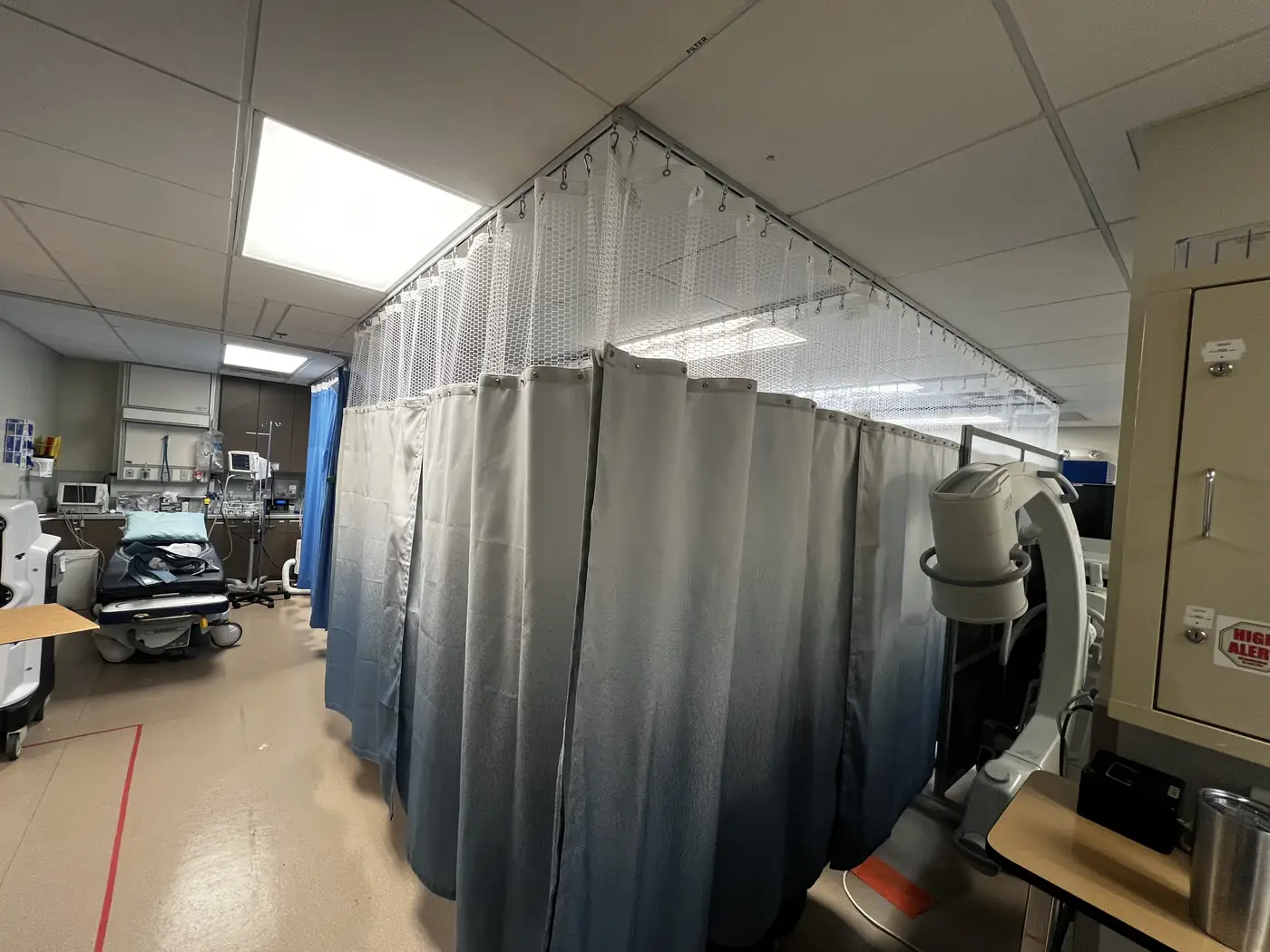
What a surveyor actually looks at
Whether you are surveyed by AAAHC, AAAASF, or The Joint Commission, and whether or not CMS is involved, curtains come up in two places on the survey: life safety and infection control. They are rarely the headline finding. They are very often the easy one.
Life safety: the gap above the curtain
A solid curtain that runs too close to the ceiling blocks the sprinkler spray pattern for the bay it encloses. The fix is a mesh panel at the top, and the mesh is not decorative — it is the part that lets water through.
The figure that causes the most confusion is how much mesh. You will hear 20 inches and you will hear 22 inches, and both are correct, because they are measured from different places:
| Figure | Measured from | What it includes |
|---|---|---|
| 22 inches | The finished ceiling | Everything: the track, the carrier drop, and the mesh panel itself |
| 20 inches | The top of the fabric | The mesh panel only, once the track and carriers are already accounted for |
A track and carrier assembly typically eats around 2 inches between the ceiling and the top of the curtain, which is where the difference goes. Specify from the ceiling and you cannot get it wrong.
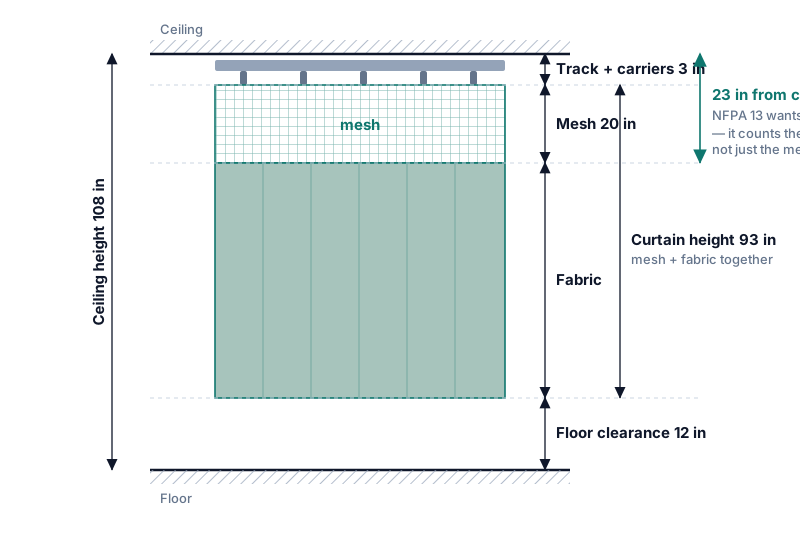
The practical failure we see most often is not a curtain ordered with no mesh. It is a curtain ordered with the right mesh for a ceiling it is no longer hanging from — a bay that was re-fitted, a track that was re-hung lower, a suspended track added under a high deck. The curtain is unchanged and now the clearance is wrong.
Infection control: the edge, not the middle
Contamination on a privacy curtain concentrates where hands go, which is the leading vertical edge and the bottom third — not the large clean-looking expanse in the middle that gets photographed. Any change schedule built around how the curtain looks will be built around the wrong part of it.
What a surveyor tends to ask for is not a spotless curtain. It is evidence of a system: a documented change interval, a record of when each bay was last changed, and a defined trigger for an unscheduled change. If you cannot produce the record, the interval does not really exist.
The scheduling problem
A hospital ward can usually give up a bay for an afternoon. A surgery center cannot: an empty pre-op bay in the middle of a block is a case that did not happen.
So the work has to fit the schedule rather than interrupt it. In practice that means one of three windows:
| Window | What fits in it | Trade-off |
|---|---|---|
| Before first case | Curtain changes, carrier replacement, minor track repair | A hard stop. Whatever is not finished has to be safe to leave |
| After last case | The same work, with a softer end time | Depends on how predictable your last case is |
| A dark day | New track runs, bay reconfiguration, anything involving the ceiling | Has to be booked around your block schedule weeks out |
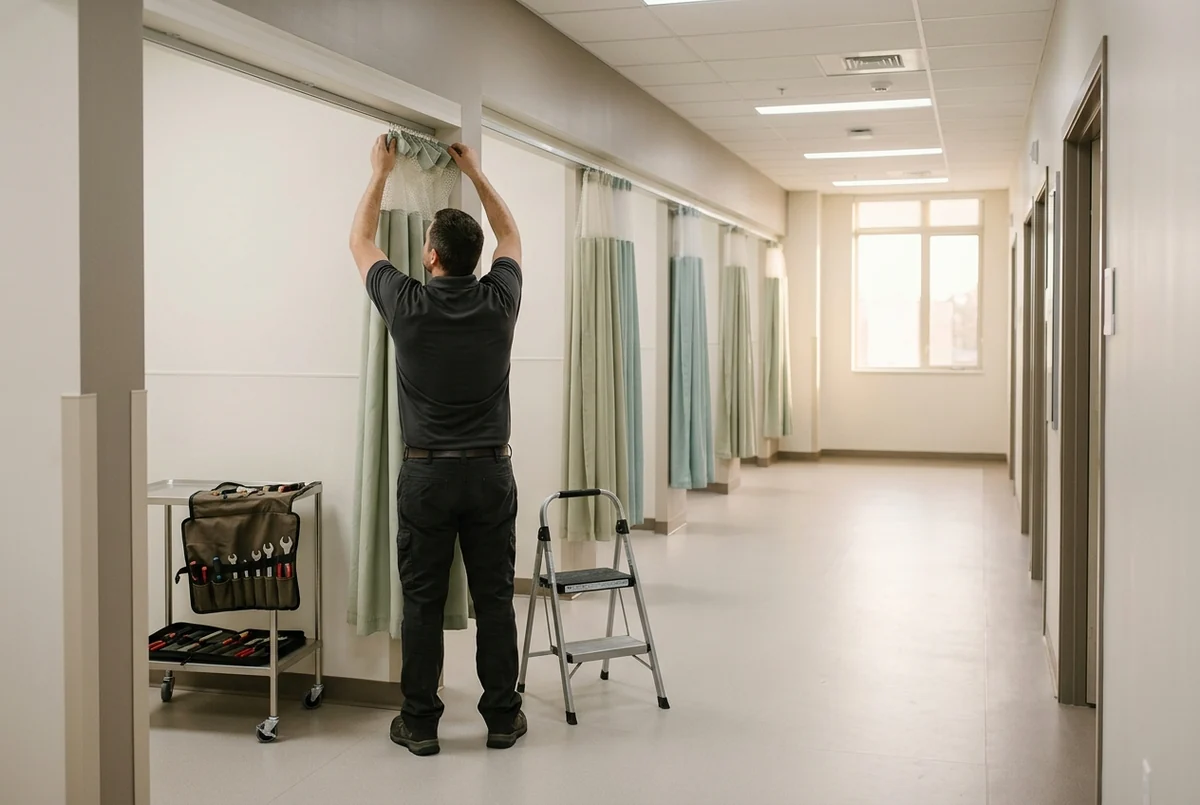
Anything that opens the ceiling grid belongs on a dark day. Anything that is a swap belongs in a window. The distinction matters when you are quoting: a job priced as a swap and then discovered to need new track does not get finished before the first patient arrives. Which is which is decided at the measurement visit, not on the morning — see curtain track installation for what the ceiling work actually involves.
Working a live corridor
Pre-op and PACU are not construction sites and cannot be treated as one. What that means concretely: no ladders left standing in a circulation path, no exposed ceiling grid left open between visits, no debris where a gurney turns, and a bay handed back with the curtain hung and drawn rather than the panel left folded on a chair for staff to deal with.
Fabric for a bay that turns over all day
The full comparison is on our fabric guide, but the surgery-center version of the decision is narrower than the general one, because the wash cycle is the constraint.
If your linen contract puts curtains through thermal disinfection — commonly around 71 °C held for a few minutes — a topically treated fabric is on a clock. The flame-retardant chemistry sits on the surface and hot washing depletes it. Inherently flame-resistant fabric has the chemistry built into the fibre, and washing does nothing to it.
That is why the honest recommendation for a high-turnover bay is IFR, even though it costs more per curtain. A treated curtain that has to be replaced early, or re-treated to stay compliant, is not cheaper by the time you have done either twice.
The California question nobody out of state answers
NFPA 701 is a test method. In California it is not sufficient on its own: the State Fire Marshal maintains a registration scheme under Title 19, and what an inspector here wants to see is that the specific fabric is registered — not a general assurance that it passes a test.
Most national suppliers will tell you their fabric passes NFPA 701 and stop there. Ask for the registration. If the answer is a test certificate rather than a registration, you have found the gap before your inspector did.
Change schedules that survive a survey
There is no universal interval, and any supplier who gives you one without asking about your bays is guessing. What actually determines it:
- Bay throughput. Fourteen patients a day through one bay is not the same exposure as four.
- Whether the bay is used for both pre-op and PACU. Double duty doubles the handling.
- Visible soiling and known exposure. Both are unscheduled triggers and both should be written down as triggers, not left to judgement in the moment.
- Whether you hold a spare set. A rotation set means a bay is back in service in minutes instead of waiting on the laundry.
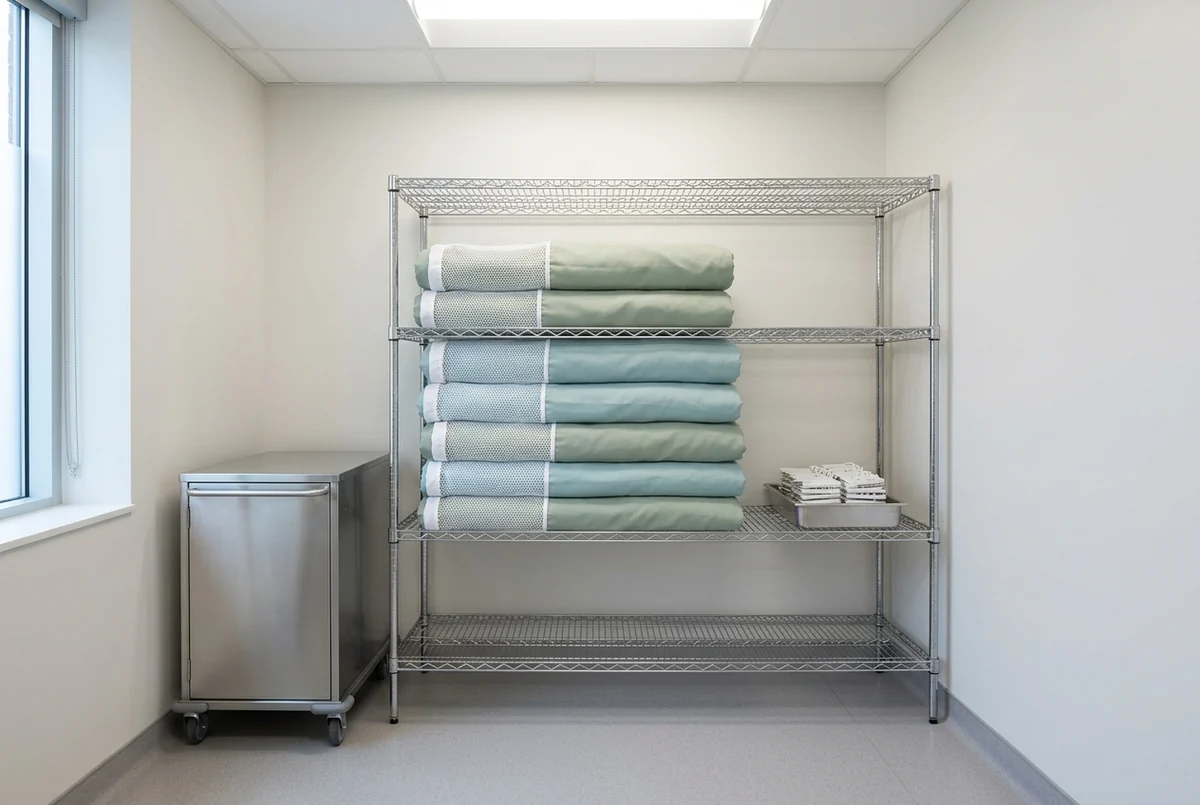
The spare set is the part most centers skip and the part that makes the schedule survivable. Without it, every change is a negotiation with the block schedule. With it, a change is a swap and the soiled panel goes to laundry on its own time. We supply the spare set cut to the same track and labelled by bay, so the swap is a ten-minute job for your own staff and the soiled panel leaves with your linen.
What we need from you to quote
A useful quote for a surgery center needs less than people expect:
- How many bays, and whether pre-op and PACU are separate rooms or one run
- Finished ceiling height, if you know it — we measure it if you do not
- Whether the existing track stays or goes
- Whether any bay has a corner return, a curved track, or a suspended track under a high deck
- Your wash process, if you know it — it decides the fabric
- Photographs of one typical bay, taken from the doorway
If you would rather work the numbers out yourself first, the measuring guide has the fullness, clearance and mesh figures with worked examples. Nothing on this page needs you to have done that — it is there because some people prefer to arrive with their own numbers.
The bays themselves are cubicle curtain installation; everything above is how that job changes when it happens inside a working surgery center.
We measure on site before anything is cut. The measurement visit is also when the physical samples come, because no screen shows you how a fabric drapes or what it feels like after fifty washes.
We work across the Bay Area and Sacramento, and we schedule around your block calendar rather than ours.