Medical Curtain Replacement
Free on-site measurement, no obligation
We reply the same business day.
Emergency? Mark it urgent and we move it to the front of the same-day queue.
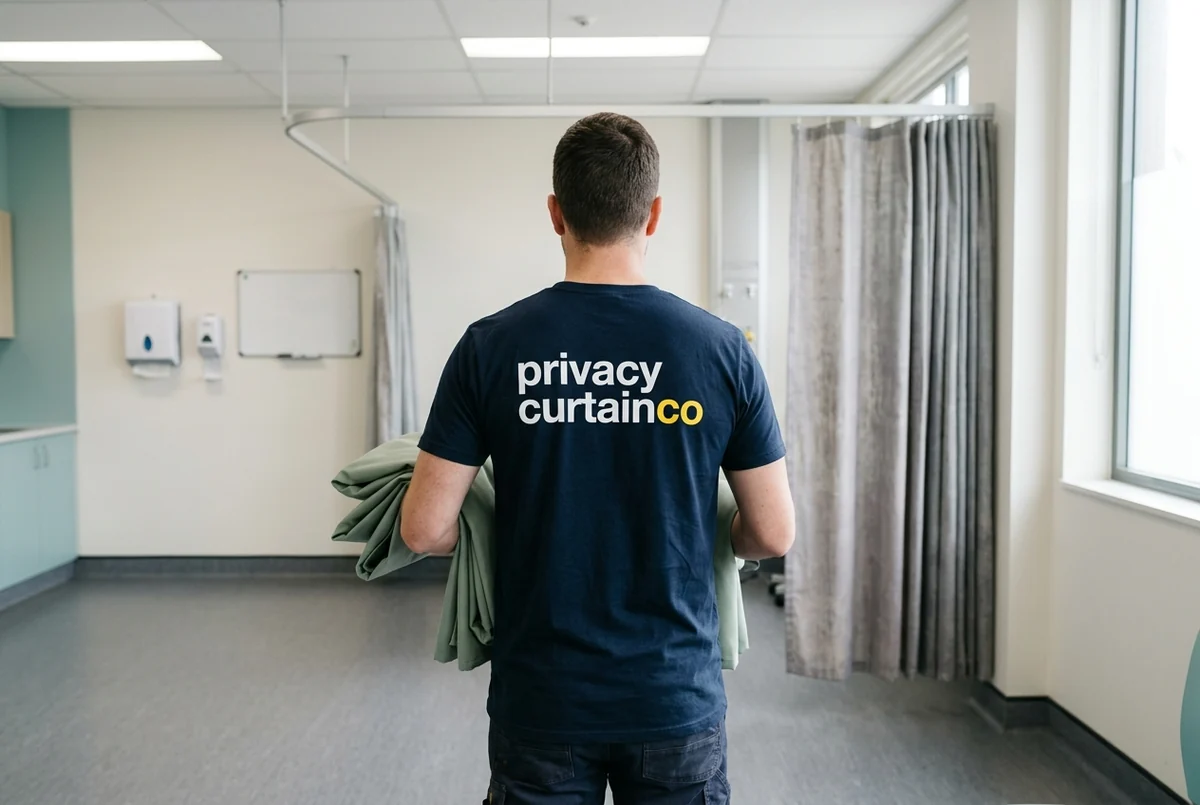
Why hire us?
Assessed before quoted
We tell you when the real problem is the track, before you spend money on new fabric.
Matched to your track
Carrier type and header matched so the new curtains hang on what you already have.
Old curtains removed
We take them away. You do not end up storing what you replaced.
Ahead of inspection
Tell us the date and we work back from it rather than quoting a comfortable lead time.
Services Included & Excluded
Complete transparency on what our service covers.
✓ Included
- On-site assessment of curtains, track and carriers
- Mesh height re-checked against current ceiling and track
- Fabric matched or upgraded to suit the area
- Removal and disposal of the old curtains
- Carrier and stop replacement where needed
- After-hours and phased fitting
✕ Excluded
- × Laundering — we supply the curtains, your own laundry washes them
- × Full track replacement, quoted as track installation
- × Sprinkler modification
- × Window treatments and blinds
How it works
Four steps, and you can stop after any of them.
-
1
Tell us about the job
A few questions online. No phone call, no card, nothing to sign.
about 2 minutes -
2
We measure on site
Track runs, drop lengths, ceiling type and clearances — so the sizes are yours rather than standard.
free -
3
You get a written quote
By email, with the fabric named and its fire documentation listed. Nothing is priced before it has been measured.
after the survey -
4
Nothing is committed until you say so
Accept the quote and the order goes in, scheduled around your hours. Decline it and that is the end of it.
the quoted price
When to Replace, and What It Involves
Who this is for
Any facility with curtains that have reached the end — a clinic whose panels have gone grey, a ward that failed a walkthrough, a practice that has just been told its mesh does not meet clearance, or a building changing hands where the new operator wants a clean start.
When a curtain is finished
Laundering solves soiling. It does not solve any of these, and continuing to wash a curtain past this point simply delays the replacement while the room looks neglected:
| Sign | What it means |
|---|---|
| Stains that survive laundering | The fabric is at the end of its usable life; further washing will not recover it |
| Torn or pulling header | A curtain about to come down under its own weight — usually the first thing to fail |
| Brittle or holed mesh | Both a privacy problem and a clearance problem |
| Thinning fabric, visible light | Privacy is already compromised |
| Heavy fading | No compliance issue, but it is what a visiting family notices first |
| Mesh too short for the ceiling | A code problem, and common after a ceiling or track alteration |
| No fire documentation on file | You cannot evidence compliance, whatever the curtain's condition |
The assessment comes first
Before quoting fabric, we check what the curtain is hanging on. It is common to find that the complaint — sticking, sagging, a curtain that will not close — is a track and carrier problem that new fabric would not have fixed. When that is the case we say so, because the alternative is you buying curtains twice.
We also re-check the mesh height against the ceiling and track as they are today. Under NFPA 13 the mesh must reach at least 22 inches from the ceiling, measured to include the gap above the curtain plus the track and carriers. Ceilings get altered, track gets re-hung, and a mesh height that was right when the building opened is not automatically right now.
Matching, or upgrading
Replacement is the natural moment to reconsider the specification rather than reorder what was there. Worth asking:
- Does this area's acuity now justify an antimicrobial finish, or was the original choice made for a different use?
- Is a disposable curtain the better answer for a room that turns over constantly?
- Did anybody ever want blackout in the recovery bay?
- Is the fabric registered with the Office of the State Fire Marshal under Title 19, as California requires for public buildings — not merely NFPA 701 tested?
Where you simply want like for like, we match the header and carrier type so the new curtains hang on the existing system without modification.
How the work runs
- Assessment. Curtains, track, carriers and mesh height checked room by room. Free.
- Quote. Fabric options with fire documentation, quantities visible, and an honest note where a room needs track work rather than fabric.
- Fitting. Old curtains down and away, new ones up, carriers replaced where they are worn. After-hours and phased by room where you need the space kept open.
- Handover. Fire documentation for the new fabric and a room-by-room record of what was installed.
What a replacement costs
Quoted per facility. What raises it: fabric grade, custom sizes, ceiling height, rooms that also need carrier or track work, and short notice before an inspection. What lowers it: doing a whole floor in one visit, keeping the existing track where it is genuinely sound, and standard fabrics in areas where the clinical risk does not call for more.
Where we work
We serve healthcare and commercial facilities across the Bay Area and the greater Sacramento region — San Francisco, Oakland, San Jose, Fremont, Santa Clara, San Mateo, Walnut Creek, Berkeley, Sacramento, Elk Grove, Roseville, Folsom and the surrounding communities. Send a room count or a few photographs and you will have a response the same day.