
⚡ TL;DR (Too Long; Didn't Read)
There is no single US federal interval. Facilities set one in a written infection prevention policy and follow it room by room; the curtain also comes down at once when visibly soiled or an isolation patient leaves. Replacing a worn curtain is a separate clock from changing it for washing.
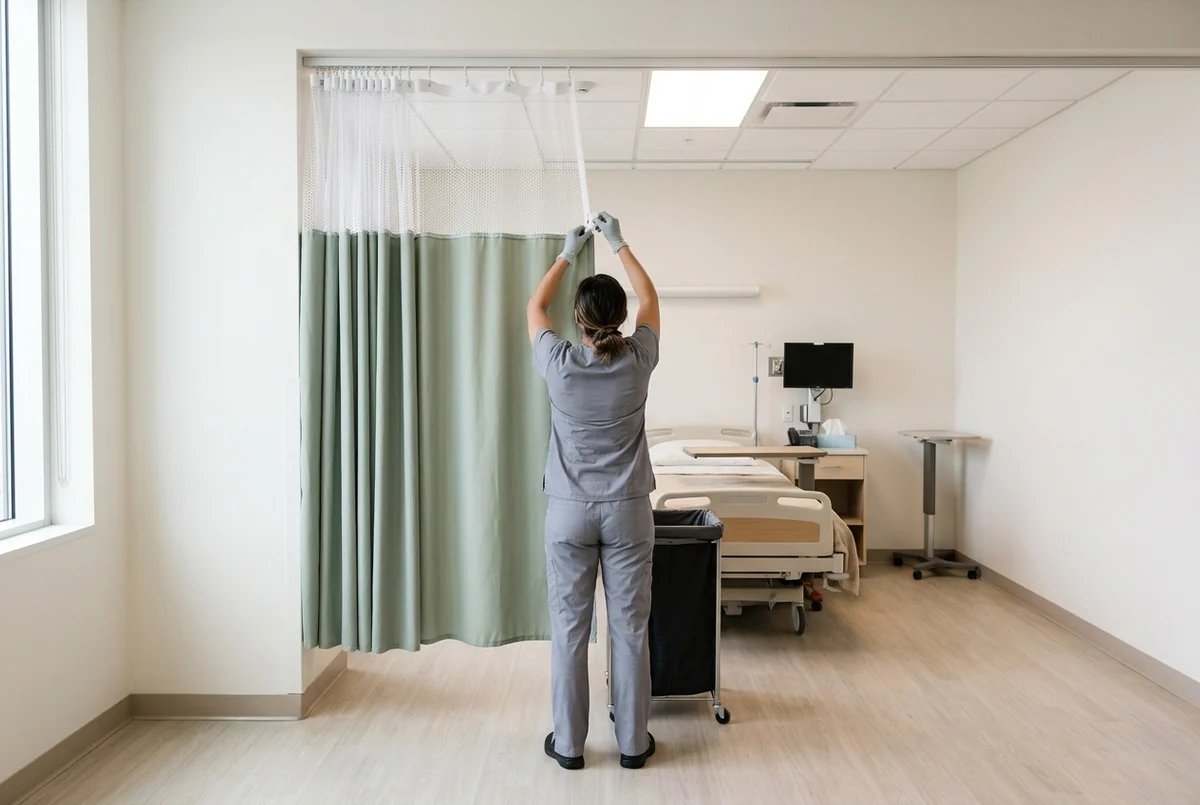
A privacy curtain can pass every visual check and still be due to come down. Because they are handled constantly by patients, visitors, and staff, curtains are high-touch surfaces, and a 2012 study in the American Journal of Infection Control found that they rapidly become contaminated with potentially pathogenic bacteria. Managing that risk requires two separate tracks: a routine washing schedule, and knowing when the fabric has reached the end of its useful life.
Changed or replaced: what is the difference?
In healthcare environments, changing a curtain and replacing a curtain are two different operational clocks. Changing refers to taking the panel down so your facility’s laundry can wash it, while a spare set hangs in the room. This happens frequently and is driven by infection prevention policies.
Replacing a curtain means removing it permanently because the fabric or mesh has failed. This is driven by fire codes, compliance inspections, and wear. A facility might change a curtain for washing six times a year, but only replace the curtain permanently every few years when it can no longer pass inspection.
When a privacy curtain must come down at once
Planning a curtain project?
Tell us about the rooms and we will come back with a written quote.
Regardless of where a room sits in its routine washing rotation, there are two events that trigger an immediate change.
- Visible soiling: Any curtain exposed to blood, bodily fluids, or visible dirt must be removed immediately. Waiting for the next scheduled wash cycle is an infection control failure.
- Isolation patient discharge: Change the curtain when a patient on contact or droplet precautions is discharged or transferred, as Alberta Health Services’ infection prevention guidance directs.
Because these events are unpredictable, facilities keep spare panels on hand so a bay is not taken out of service while the original curtain is washed.
Routine change intervals by setting
Neither the CDC nor The Joint Commission publishes a fixed, universal interval for changing curtains in non-isolation settings. Instead, the Guidelines for Environmental Infection Control recommend a risk-based approach. Environmental services, nursing leadership, and infection prevention teams set a written policy based on patient acuity and how often the curtain is touched.
In practice, most facilities land between every four weeks and quarterly, scaling the frequency to the risk level of the department.
High-acuity and emergency areas
Emergency departments, burn units, intensive care units, and 24-hour urgent care centers carry the highest risk of pathogen transmission. In these settings, patient turnover is constant and the curtains are handled heavily by clinical staff during rapid interventions. Facilities typically write their policies to require changes at least every four weeks for these rooms.
General inpatient and outpatient clinics
For standard inpatient wards, commercial room dividers in non-clinical areas, or ambulatory surgery centers where patients stay longer or the acuity is lower, the interval often extends. A common standard is quarterly, though some low-traffic outpatient spaces may stretch to biannually. The exact interval matters less than having the policy written down and strictly followed. An inspector will check the facility’s written protocol against the actual room logs to ensure compliance. If a facility has a monthly policy but no logs to prove it, they are in a weaker position than a facility with a quarterly policy and perfect records.
4 signs that washing is no longer enough
A rigorous washing schedule keeps a facility safe, but thermal disinfection is harsh on textiles. Eventually, washing only delays a necessary replacement while making the room look neglected. These four signs mean it is time to throw the panel away:
- Stains that survive a wash: Permanent discoloration that does not come out during laundering means the fabric is finished.
- Tearing headers: The reinforced top edge where the grommets sit takes the most stress. Once it starts pulling or tearing, the curtain will soon hang unevenly or fall.
- Brittle or holed mesh: The open mesh at the top is fragile compared to the solid fabric below. When it develops holes or turns brittle from repeated hot washing, the curtain looks ragged.
- Mesh height out of compliance: This is the most common inspection failure. Under NFPA 13, the mesh must reach at least 22 inches down from the ceiling. If a track is lowered or a ceiling altered, the old curtain may no longer meet the clearance rule and must be replaced entirely.
Fabric choices for frequent washing
Because hospital curtains are subjected to harsh washing cycles, the fabric must be specified to survive the process. An inherently flame resistant (IFR) hospital curtain fabric maintains its flame-retardant properties regardless of how many times it is washed. Topical treatments, on the other hand, wash out over time. When a curtain is on a monthly rotation, specifying an IFR fabric is the only reliable way to maintain fire code compliance without re-treating the material.
Frequently asked questions
Does The Joint Commission require a specific interval?
No. The Joint Commission does not mandate a specific timeframe like “every three months.” Surveyors look for a clear, written infection control policy tailored to the facility’s risks, and they verify that the staff is actually following and logging the changes according to that policy.
Can privacy curtains be disinfected in place?
No. Medical curtains are porous fabrics and cannot be sprayed or wiped down to achieve disinfection. They must be removed and exchanged for clean ones, which is why a rotation system is essential.
Planning a replacement round? Tell us about the rooms and we will come back with a written quote.
Sources
- Ohl et al., Hospital privacy curtains are frequently and rapidly contaminated with potentially pathogenic bacteria, Am J Infect Control, 2012.
- Guidelines for Environmental Infection Control in Health-Care Facilities, Centers for Disease Control and Prevention, 2003 (updated 2019).
- Frequency of Changing Privacy Curtains – IPC Recommendations, Alberta Health Services (Canada), revised 2024.
- Privacy Curtain Co FAQ and Technical Guidance.